
Published Aug 25, 2026 · Updated Sep 24, 2026
Apple just told a federal judge how much it wants to charge when an iPhone app sends you to a website to buy something — and the answer is up to 15 percent. The proposal landed August 13 in the long-running Epic v. Apple case, and it is the United States counterpart to the EU App Store overhaul we covered separately.
The short version for you, the user: nothing changes today. This is a proposal sitting on a judge’s desk, not live policy. But the number the court eventually settles on will shape whether you start seeing “save by buying direct” links inside your favorite apps — and whether those apps actually get cheaper.
Jump to a section
What Apple Is Asking For
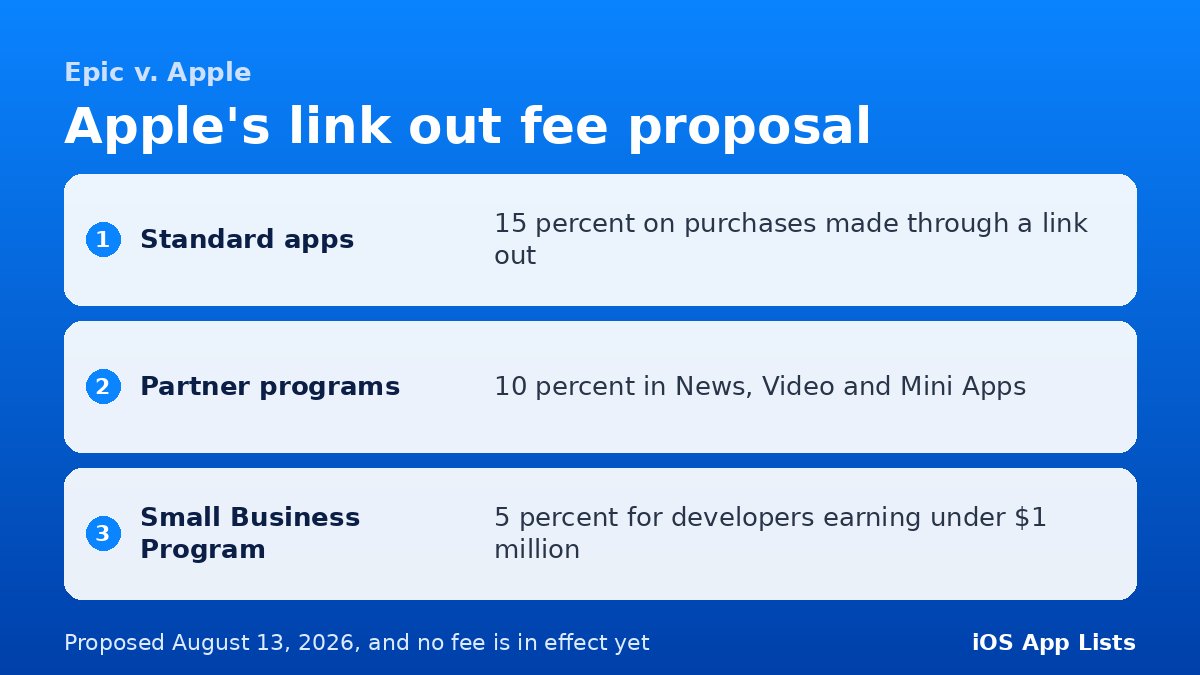
Apple wants to collect a commission when someone taps a link inside an app, lands on the developer’s website, and completes a purchase there. These are called “link-out” or “external” purchases, and right now Apple collects nothing on them. Here is the fee schedule Apple proposed to the U.S. District Court for the Northern District of California:
- 15% for standard apps, which normally pay a 30% cut on in-app purchases.
- 10% for apps in the News, Video, and Mini Apps partner programs, plus subscription renewals.
- 5% for apps in the Small Business Program, which earn under $1 million a year.
The practical example everyone uses is Spotify. If you open the Spotify app, tap a link that takes you to Spotify’s website, and buy a subscription there, Spotify would owe Apple 15% on that sale. Apple argues the rates come from expert analysis and are lower than the link-out fees Google charges in its own Epic case.


How We Got Here
This fee has a long legal history, and the timeline explains why the number matters.
Back in 2021, a judge ordered Apple to let developers link to purchase options outside the App Store. Apple eventually complied — but paired the links with a 12% to 27% fee that was nearly identical to its regular commission once you factored in third-party payment processing. Epic Games cried foul, and Judge Yvonne Gonzalez Rogers found Apple in contempt of court. In April 2025, she barred Apple from charging any fee on link-outs, and since then Apple has collected no money when an app sends users to a website to make a purchase.
Apple appealed. The Ninth Circuit upheld the contempt ruling but said Apple is entitled to compensation for its intellectual property — so it sent the case back to the district court to figure out what a fair fee actually is. Apple separately appealed the contempt finding to the Supreme Court, which agreed to hear it in the term that starts October 2026. Apple tried repeatedly to pause the fee-setting process until the justices weigh in, but the Supreme Court denied that request, so the district court is moving ahead now.
What It Means for You
First, the headline: nothing about how you pay for apps changes today. This is a proposal awaiting court approval, and the final number could land anywhere from 0 to 15 percent.
That zero is more than a theoretical floor. The appeals court suggested the fee could be limited to Apple’s direct costs of facilitating a link-out — which is effectively zero. If the court goes that direction, developers could route you to their websites for free, and you would likely see a wave of “buy direct and save” offers.
If Apple’s 15% stands, expect less drama. A developer moving you from a 30% in-app cut to a 15% link-out fee still has to pay roughly 3% to a payment processor, so the real savings are only about 12 points — and history says developers rarely pass savings that small on to you. The most likely outcome in that scenario is a few apps quietly adding a “buy on our website” option without meaningfully changing prices.
The bigger wildcard is the Supreme Court. If the justices rule that the contempt finding was wrong, the entire fee-setting exercise could be voided, and we would be back to square one. For now, treat every number here as provisional.
How This Differs From the EU Overhaul
These two stories get confused a lot, but they are separate proceedings with different rules.
The EU App Store overhaul is a settlement with the European Commission under the Digital Markets Act. It replaces the Core Technology Fee with a flat 5% commission, allows alternative app marketplaces like AltStore PAL and the Epic Games Store, and takes effect October 1, 2026 — for users in the European Union only.
This U.S. fee proposal comes from a federal court in the Epic v. Apple case. It covers only purchases made through links to outside websites, creates no alternative app stores, and is not in effect yet. If you are in the United States, this is the one that applies to you — once the court actually sets a number.
What to Watch Next
Three things are worth following.
First, the district court will now evaluate Apple’s proposal and hear Epic’s response before setting a fee. Epic has already signaled it thinks the proposal does not go far enough, so expect a fight over the number.
Second, the Supreme Court hears the contempt question in its October 2026 term. That ruling could reset everything.
Third, watch how developers respond. If a few big apps start advertising “buy direct and save” the moment a fee is set, that is your signal the link-out era has actually begun. If they stay quiet, the savings were not enough to bother with.
Frequently Asked Questions
Do I need to do anything right now?
No. This is a court proposal, not live policy. Your apps, subscriptions, and payment methods work exactly as they do today.
Will apps get cheaper?
Probably not by much. A 15% link-out fee still leaves developers paying a payment processor, so the net savings are modest — and developers rarely pass small savings on to users. The only scenario where prices might move is if the court sets the fee near zero.
When does this take effect?
Not until the district court approves a fee, and possibly not until the Supreme Court rules on the contempt question. There is no effective date yet.
Can I already buy outside the App Store?
Developers have been allowed to link out since 2021, but most do not, partly because of years of legal uncertainty over what the fee would be. Once a fee is set, more apps may add the option.
How is this different from the EU change?
The EU overhaul is a DMA settlement that takes effect October 1 with a flat 5% commission and alternative app stores. This U.S. proposal is a court-ordered fee on link-out purchases only, with no alternative stores, and it is not in effect yet.